Deafinitely not funny

I’ve been trying to find funny cartoons about deafness, and it has been surprisingly difficult.

If you look on the net you can find cartoons, but a substantial proportion feature someone shouting at a deaf person.  Shouting at someone with hearing loss is not a great thing to do.  Firstly because it feels just as aggressive to the recipient as if you were shouting in anger.  Secondly, and more importantly, because it makes it far harder to lip read what someone is saying, because shouting distorts the natural lip shapes.  In any case, with modern hearing aids volume is rarely the problem.

Thankfully, in real life people don’t shout at me.  In fact, the loveliness of people I meet casually and try to communicate with never ceases to amaze me.  I say something like “I’m deaf.  I can only understand speech if I can see your face, so that I can lip read” and people respond “OK, fine”.  They turn to look at me and they largely remember to keep looking at me.  If they forget (understandably, most people don’t need their eyes to hear) and turn away I might say “Sorry, I didn’t catch that”. They will say “Oh, I forgot, sorry” and turn their head to face me again.  They never start bellowing.

People don’t even start shouting if I still have trouble understanding.  This happens because lip reading is difficult and usually at least partly based on guesswork.  (I feel another post coming on but let’s leave that one for the moment).  The window cleaner looked bemused when it took me four goes to get “have you paid for last time?” but he didn’t raise his voice.  Nor did the supermarket checkout operator when it took me a similar number of attempts to understand “have you had a good day so far?”  (Answer…..not really).  Believe me, I can understand why people would want to have a good shout in these circumstances, which makes it all the more creditable that people keep their cool and persist so cheerfully.

It’s not always plain sailing.  One day I said my little spiel to a plumber come to mend a radiator leak and he replied, in broad Lancashire, “tha’ll have trouble wi’ me then lass, ah’ve got toffee in’t mouth”.  But we managed.


Decisions Decisions

17005454_s
Copyright: Cole123RF / 123RF Stock Photo

When I first had hearing aids I grew my very short hair slightly longer to hide them.  It was a vanity thing.  When people said “goodness, I didn’t know you had hearing problems – you could never tell” I was very pleased.  This isn’t an approach everyone with a hearing loss shares.  The letters page of the magazine produced by Action on Hearing Loss (formerly the RNID) sometimes reverberates with people getting very cross about manufacturers who advertise hearing aids as “invisible…..no-one will know you are wearing them”.  They feel that we should be more upfront about our deafness, and stop it being quite so much a hidden disability.  I can see their point, but admit that I was quite happy to hide for as long as I could.

Things have changed now that my hearing is much worse.  I’ve got very short hair again and everyone can see my hearing aids.  That’s a good thing now, because people I meet casually might get a first prompt that all is not well (that is, before I completely misunderstand what they say and veer off on some strange conversational tangent).  I also like it that other people with hearing loss sometimes come up to me and strike up a conversation, starting it, “I see you have hearing aids……”

So my view is that we all reach individual decisions about what works for us on this, and that might change over time.  We shouldn’t criticise others for their choices.

Writing about those decisions reminded me of the tiny deafness-related decisions I make, many times, every day.  Sometimes, as you all know, people with hearing problems pretend they have heard something when they haven’t.  We shouldn’t do it, because it is all too easy to make a disastrous mistake and nod and smile when the right response would be to say *oh how terrible, I’m so sorry”.  But there are times when my ability to say yet again, “I’m sorry, I didn’t hear that, could you repeat it for me” just fails me – I’ve said it so many times that day. I decide to zone out for a while.

There’s also the aspect of trying not to completely dominate other peoples’ conversations.  When I am with more than a couple of other people there are inevitably conversations going on between the others that are not particularly directed at me.  A person without hearing loss would be able to hear all of it and know when to chip in, but you would be driven mad if I interrupted every time anyone said something that I didn’t catch. So I decide when to butt in and when not to.

There is also the issue of deciding how much to explain to people you don’t really “meet” but who you exchange some pleasantries with.  An example of that scenario is with an artist who, last summer, was painting a scene on a local canal towpath where I often walk our dog.  As I passed him sat at his easel I was mainly focussing on how to stop a friendly but sometimes shall-we-say-over-exuberant black Labrador causing oil paint mayhem but I would call out “Good Morning” and walk on by.  One day I was fairly certain I could hear the man saying something as the dog and I charged past.  So I turned and said “I’m sorry, did you say something?  I’m deaf and didn’t catch it”.  “Ahhh” he said “that explains it…I’ve been trying to talk to you the past two or three times I’ve seen you but you just ignore me”.  So we had a chat.  Indeed the next time I saw him he had researched how to say “Good morning Vera” in sign language (which was a shame because, living a life surrounded by people who can hear, I’ve never learnt it).  He and I became firm friends, until his painting was finished and he moved on to some other place.  It was an excellent example of how people can assume you are being rude, or standoffish, by ignoring them.  On the other hand, it’s not really feasible to tell your life story to everyone you pass on a walk.

So many decisions.  I was somewhat horrified to read recently the theory that we all have our daily quota of decision making ability, and once that’s gone decisions get far harder.  If it’s true I’m destined for a life of dithering, as all my decision making quota gets used up on variants of the above.


Tweet Tweet

As I explain in About This Blog it has been around 40 years since I heard birdsong. I can hear rooks and ducks if they are very close by (with their deep “caw caw” or “quack quack”) but that’s about it. Anything in the upper octaves escapes me completely. It doesn’t upset me. In fact, I really like it when people say “oh listen – the first curlew” (they return to nest around here in March) or “the birds are really loud this morning – spring is definitely coming”. It keeps me in touch.

Actually, I admit, if a bird with a loud high pitched song is REALLY close by, and it is otherwise quiet, I CAN hear something. I can hear the very deep part of their song. So a blackbird or thrush will sound “crack, cruck, crackity” because I can’t hear all the nice melodic bits. Today I was out with the dog, everything was calm and peaceful and rural and suddenly one of those “crack, cruckity” noises came from very close by. I peer about, stand still, annoy the dog (she wants to be off chasing her ball, not stood here staring at trees) and then there it is – a song thrush on a high branch singing away like billy-o. It is so close I can see its bill moving – to sounds lost to me except for bits of the bass line.

Now for the funny part. When I was a child my grandpa, in common with a lot of elderly men in mining areas of the North East, bred canaries. He had an aviary in the garden and I spent hours and hours in there with him looking after Peter and Pam, Dick and Dolly and the rest (I still have the book he recorded their names in). So, when I see a bird like that song thrush singing, in my head the sound I hear, or rather the sound I imagine, is a canary. It must be imprinted in my brain because I heard it so often way back then.

I don’t mind at all if you laugh. I find it hilarious that I see a song thrush or blackbird singing and my brain “hears” a fifty year old canary.

SAM_4498
calm, peaceful, rural

Subtitle It

I can’t imagine what life must have been like for people with hearing loss before the advent of subtitles, on the television and on DVDs etc. I love them. They give me another part of life where I don’t need to worry about my ears.

Indeed I’m sure that using subtitles sometimes gives me a better hearing experience than people with good hearing. Do you remember last year when everyone was enjoying Wolf Hall but moaning about not being able to follow the whispered speech in badly lit Tudor halls? I was happily following every mumble, occasionally saying to people “why don’t you just turn on the subtitles?”

And it’s not just the TV and DVDs. I don’t know if you’ve heard of MOOCs? It stands for massive open online courses. These are a recent great leap forward in leisure learning where you can follow, at no charge and in your own time, high quality courses on a huge variety of subjects, mainly provided by university departments. When I first heard of these, and that they were partly video based, I assumed I’d not be able to take part, but one provider at least (Future Learn) subtitles every video. Fantastic. I have enjoyed excellent courses on Hadrian’s Wall and Richard III.

Going back to the television, at the moment subtitling provision is patchy. However, things may be improving, spurred on by a campaign, Subtitle It!, run by Action on Hearing Loss. The main problem is video on demand or catch-up channels. BBC iPlayer subtitles almost everything but the other on demand channels don’t have nearly such a good track record – indeed only about a quarter of on demand programmes are subtitled, even if they were originally broadcast with subtitles. For example, one of my favourite TV programmes is Channel 4’s Homeland. Last season it was subtitled if I watched it live but if I couldn’t be in front of the television at 9pm on a Sunday night there were no subtitles on the catch up service – so I would have to miss the episode. This might seem like a trivial problem (especially if you don’t like Homeland) but it means that people with hearing loss are being cut off from something that everyone else is increasingly taking for granted. My view is that providing subtitles for deaf people is like providing ramped access for wheelchair users – it is a slight accommodation that makes a huge difference.

If you want to read more about the Subtitle It! campaign look at this, or, if you would like to read about a brilliant campaign by teenager Jamie Danjoux to get Sky to increase their subtitling click here. He explains how the lack of subtitles on his favourite programmes means he misses out on sitting down to watch with his brothers and sisters.

Sometimes when I rave about subtitles people tell me how terrible they are, mainly because they have been watching live programmes where the subtitling is provided by speech recognition software. Indeed, huge howlers abound with this technology. There are lots of great examples online but my favourites are calling for a “moment of violence” at the Queen Mother’s funeral (it was a moment of silence) and, on BBC Breakfast when interviewing a farmer whose pigs “love to nibble anything that comes into the shed, including our willies” (yes, it was wellies!). So I avoid the live programmes when I can, until speech recognition technology improves.

Talking of which, yesterday I tried out an app that uses speech recognition software to provide a live “translation” of speech onto a tablet or smart phone. It featured on a list of apps possibly of use to deaf people and it was pretty good for simple sentences, but less good for anything complex. I couldn’t really see how it would help me but it was fun to play. My name (Vera Brearey) came out “beer brewery”. What me? I hardly drink at all.

Close to Home - cl_c081014.jpg
http://www.CartoonStock.com


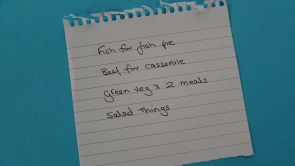
Forgotten Shopping

SAM_5438

Because there are so many things I can’t hear I’m semi-constantly aware that my life is not quite like most other people’s. The big example of course is speech. I’m aware of people around me speaking all the time but I know that I can only understand what they are saying if I tune in, look at the speaker and concentrate.

I know that, and I’m used to it. Life goes on. But sometimes things happen to remind you of things you are missing that you’d forgotten all about. An example happened in the Post Office in the other week. To set the scene, in our household my husband does a weekly online grocery shop but I do the shopping, in our local town, for things I want to see before I buy them (things like meat, fish and fresh veg). I enjoy going round the shops and my husband doesn’t so it’s a very good division of labour. Also, I can do it and scarcely feel deaf at all. Shopping is quite easy for a lip-reader, I find, because the script is so limited. At the supermarket checkout the operator might say “would you like help with your packing?” or “do you need any bags?” or “do you have a club card?” I’m expecting all of those and just have to lip read (or guess) correctly which one they have said and bob’s your uncle. In a confident mood I might even start a short chat about the weather – again, you know where the conversation is going so it’s easy to keep up. In the butcher if you state what you want clearly enough – “lean lamb for a casserole please, about a kilo” – not much else needs to be said until they say the price, and that’s fine because it shows on the till in front of you. No lip reading needed. Perhaps another “would you like a bag?” and you’re done. Success. “Thanks a lot….bye” and you’re off.

SAM_5439
My favourite butcher

But on this day my husband was with me for some reason when I needed to go to the Post Office for some stamps. I said what I wanted, put my letters on the scales, grimaced at the fact that they were slightly heavier than ideal and would cost more than the standard rate….all going well. Now at this point you need to know that it is one of my husband’s most endearing characteristics that he chats easily to complete strangers of all types and on all occasions. If we are out fell walking he doesn’t just say hello or good morning to passing walkers, as most people would. He stops, and, given the slightest encouragement, he’s off. Where we are going, where they are going, by what route, where we live, where they live…..sometimes things progress for so long he gets on to describing our dog’s various medical conditions (she sometimes has to wear a boot on a back paw, so people ask)……..a few jokes added in and we go our separate ways. “What a friendly chap” they think. “His wife was a bit uncommunicative”.

So, back to the post office. I’m being served quite swimmingly and my husband makes some quick quip to the person serving me, which I missed of course. She replies and they start laughing. Then the other person serving (it’s a counter in a corner shop – they aren’t behind screens) says something else, then someone else in the queue joins in and they are all laughing. Funny quips pinging backwards and forwards. It was lovely, but goodness knows what it was about. Experience tells that asking for a lip readable running commentary on a quick joke is the road to madness, it just doesn’t translate.

So, a forgotten thing. How other people shop…….

SAM_5442

Air Raid Warning

When I was being assessed for a cochlear implant (see About This Blog) the lovely staff at the centre I attended referred me for a free smoke alarm for people with hearing loss.  With my hearing aids in I can hear the smoke alarms at home quite well (whenever I burn the toast) but without them there would be no chance.  So at night, on the rare occasions when my husband is away, I’m quite vulnerable.  Well, very vulnerable.  Nothing wakes me once I’m asleep with my hearing aids out.  A bomb going off might work, but only because of the vibration.

The process of referral was quite a long one, taking several months from start to finish.  The Cochlear Implant Centre referred me to the disabilities team at the Social Services Department, who visited to make their own assessment.  Then the Social Services people referred me to the Fire Brigade, who visited to make a fire risk assessment.  This was a general risk assessment of fire safety issues, not specifically hearing loss related.  After that, the very friendly and chatty fire officer who visited confirmed that he would order me the relevant piece of kit.  He returned, a few weeks later, and fitted what looks very like an ordinary smoke alarm but which has a receiver that stands on my bedside table, with a lead to a slim plastic box I would put under my pillow if I was sleeping on my own.  The receiver looks like this.  (It is a Silent Alert SignWave receiver). SAM_5436

Then he tested it.

WHOOP WHOOP WHOOP it bellowed, for all the world like an air raid siren on high alert.  Simultaneously a powerful light flashed on and off, like a lighthouse on strobe mode.  Whilst all this was happening the box under my pillow jumped up and down like a mad thing, possibly risking a fractured skull if I didn’t react to it quickly enough.  In real life, by this time, the whole village would be awake (which is reassuring, so long as they realised it was a fire and not an imminent invasion).  “Works, doesn’t it?” the fireman grinned “you wouldn’t sleep through that”.

I certainly wouldn’t, and am very reassured.


Ring Ring


Not being able to hear on the telephone has been gradually eating away at my confidence for a couple of years now, ever since my hearing declined from missing the odd word on the phone to missing most of them.  My worst experience was realising that a close family friend was telling me that someone had died but not being able to understand who.  It was his wife.  So I don’t answer the phone and I don’t make phone calls.  My lovely husband fields things for me but it’s still pretty humiliating.  And no, that’s not too strong a word.  Not being able to make a phone call is not the “me” I’m used to being.

But there has been a miracle, in the form of the Next Generation Text Service (NGTS).  “Wozzat?” you say, and indeed none of my deaf or hard of hearing friends had heard of it.  Essentially it is a specialist switchboard service, where the operators listen in to your conversation, and type what the person at the other end is saying so that you can read it on your computer, tablet or smart phone.  It is provided by BT and it is free.

I found the whole concept a bit mystifying to begin with.  How would my husband get calls, or make calls, if our telephone was linked to this service?  Would we need two telephones?  The Hearing Link Helpdesk came to my rescue, with a clear, detailed and incredibly rapid answer to my baffled questions.  (Even better, the answer came from someone with a similar level of hearing loss so I immediately felt confident she knew exactly what I meant).  And of course you don’t need two phones.  There is a prefix (18001 for outgoing calls, 18002 for incoming) which you just link to your normal number.

So I used the NGTS app to link our phone to the service (which took a couple of tries but wasn’t too difficult) and had a go.  Friends, it works.  You open the app on your iPad (or other tablet, or smart phone if you have one, or computer), dial the prefix, dial the number you want to call and words start appearing in front of you.  “Ring ring”, it says.  “Ring ring”.  Then “the call has been answered” then “Hello, Bill Bloggs here GA” and, knowing that Bill is there you GA (go ahead) and say…..well, say whatever you want to say.  Just typing it is making me smile.  It really works.

It is clunky compared to a normal conversation, because of the delay whilst the operator types what the other person is saying.  So with friends I am still mainly using e mail to communicate.  But it can be very useful when I’ve needed an answer to something more quickly than I could guarantee an e mail response.

The first time I used NGTS was when I needed to pick up some new glasses from the optician.  They had said they would be ready on a particular Sunday but, on the day, I was starting to think maybe I should wait a few days in case they hadn’t arrived.  Then I remembered “I can ring them”.  So I did, the new glasses were ready and I drove into town with a smile on my face.  It sounds ridiculous, but you become so used to not communicating that it feels really liberating when you can.  Previously I would either have risked going into town knowing that it might be a wasted journey, or waited a few days to be sure.

On other occasions I’ve used the service to make appointments.  I had abandoned the telephone on these occasions because I would sometimes mis-hear what the appointment was and turn up at the wrong time.  Or else spend embarrassing ages on the phone saying “so the appointment is for 10am on Monday….have I heard you correctly?” and then not be sure what they had said in reply.  Now I’m confident again and have won back some independence.  I’ve even managed to sort out a tricky problem with my pet insurer’s call centre.  Eureka.

So I cannot tell you how delighted I am with NGTS.  I tell all my friends with hearing problems about it (and indeed all my friends who haven’t got hearing problems………).


Image copyright:  damedeeso©123RF.com